House Programme - Juego del Tiempo (The Play of Time)
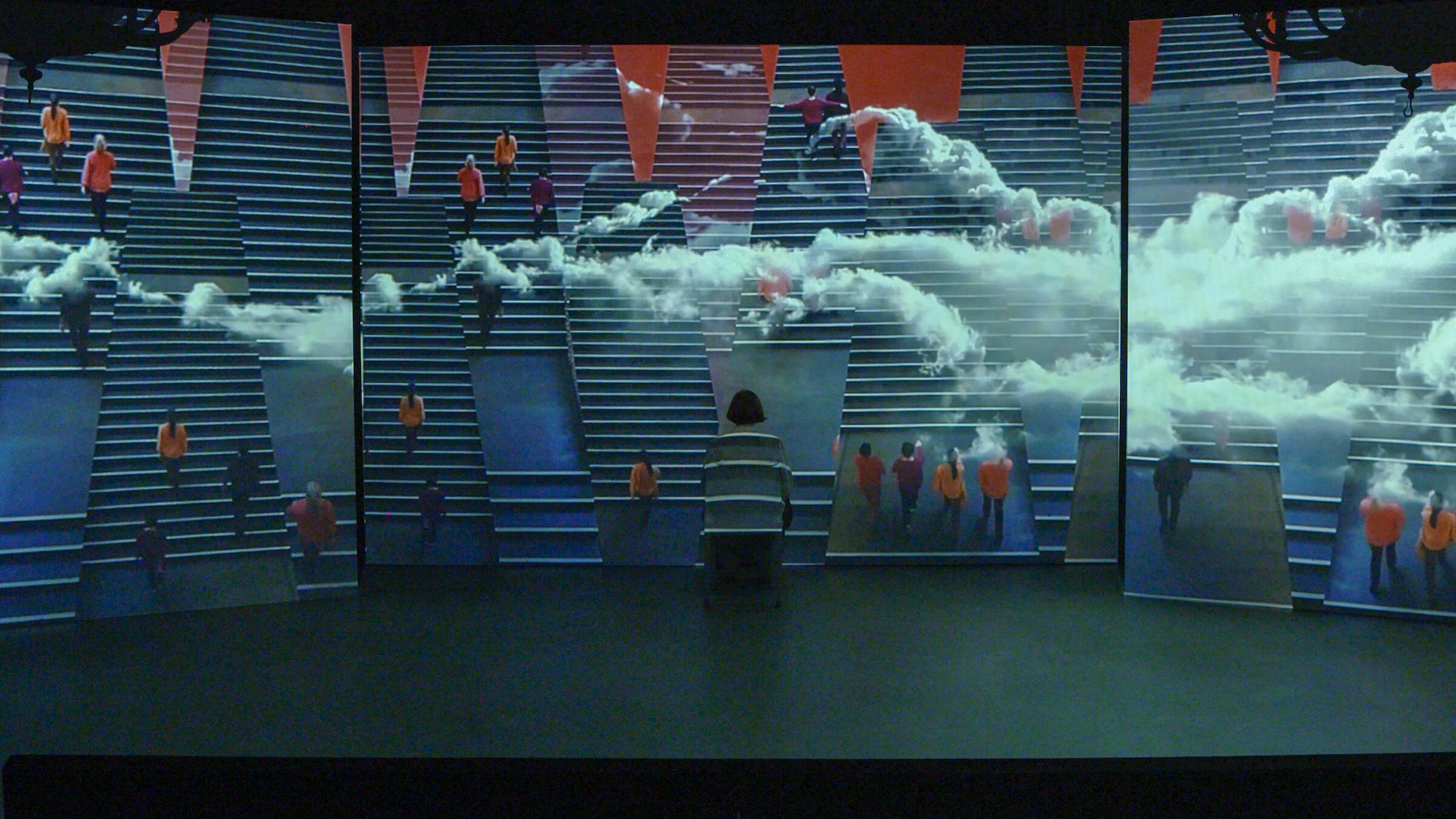 Photo credit: Margarita Bali
Asian Premiere
A dance and multimedia performance that intertwines body, time, and archive
Juego del Tiempo (The Play of Time) is an innovative reinterpretation of the artistic legacy of Margarita Bali, one of the pioneering figures of Argentine contemporary dance. The work is rooted in processes of selection, appropriation, editing, and invention that expand the notion of artistic memory. Here, the body itself is the artist's archive – a site where memories, omissions, creative traces, and possible futures are inscribed.
The piece acquires a distinctive and powerful character by placing its creator, at 82 years of age, centre stage. Fragments of past works, images, sketches, and germs of an idea are revisited, transformed, and reimagined in the present by Bali and her shadow. Through this contemporary pas de deux with her own artistic biography, the work unfolds as a dialogue between archive and present, between lived experience and ongoing creation, between what endures and what is continuously reinvented.
In this way, Juego del Tiempo transcends personal homage to become a universal reflection on memory, transmission, and the inexhaustible power of artistic creation.
- Free Seating.
- The performance runs approximately 60 minutes without intermission.
- Registered participants are required to arrive and be seated at least 15 minutes before the scheduled programme start time. Seats will be held until the scheduled start time; any unoccupied seats at that time will be released to standby attendees.
- Please switch off mobile phones and any other sound and light emitting devices.
- Photography, audio, and video recording are not permitted during the performance.
- Eating and drinking are strictly prohibited during the performance.
- Programmes are subject to change without prior notice. HKPAX reserves the right to final decision regarding programme arrangements.
- This performance incorporates video containing scenes of nudity.
Concept : Gerardo Litvak
Performer and choreographer : Margarita Bali
Music composition and sound design : Gabriel Gendin
Video creation and design : Margarita Bali
Lighting design : Eli Sirlin
Costume design : Mónica Toschi
Set design: Graciela Galán
Mask Creation : Eugenia Bekeris
Technical and Audiovisual Assistant : Agustina Piñeiro
Choreographic Assistant : Carla Rímola
Costume Assistant : Agustina Gobbi
Executive Production and Distribution : Marina D’Lucca
Direction : Margarita Bali & Gerardo Litvak
Margarita Bali (Director, Performer)
Margarita Bali is a choreographer, dancer, videographer, and pioneer in video installation and mapping. She has served as co-director of Nucleodanza (with Susana Tambutti) for over 25 years.
Her distinguished career includes the Guggenheim Fellowship (1998), the Alexander Onassis Foundation Prize (2000), the Faena Prize for Art and Technology (2006), the Gyula Kosice Prize (2012), and the National Endowment for the Arts Lifetime Achievement Award (2017).
With over 40 works for Nucleodanza and 15 award-winning video–dance pieces, Bali has toured extensively across Europe, Asia, and the Americas, performing at prestigious venues such as the American Dance Festival, Steps Switzerland, and the Gulbenkian Foundation. Her acclaimed video installations Hombre Rebobinado and Galaxias Inmersivas and her large-scale architectural mapping project Pizzurno Pixelado have been showcased in major museums and cultural centres.
Bali holds a degree in Biology from the University of California, Berkeley.
Gerardo Litvak (Director)
Gerardo Litvak is a director and choreographer. He currently serves as Head Professor for the Bachelor of Arts programmes in Dance and Drama at the National University of the Arts (UNA), Buenos Aires. Previously, he served as Executive Director at the Instituto Prodanza for the Ministry of Culture of Buenos Aires.
Litvak's award-winning work has been presented at national and international festivals with the support of organisations such as the John Simon Guggenheim Foundation (US), Freiburger Theatre (Germany), and Teatro Colón Experimental Centre, Iberescena, and the Cervantes National Theatre (Argentina). He has received numerous scholarships and grants from the Fulbright Commission, the National Fund for the Arts, the International Theatre Institute (ITI), the Goethe Institute, the American Dance Festival, Fundación Antorchas, and the Research Institute of the Dance Department (UNA), as well as the Rencontres Chorégraphiques Internationales de Seine-Saint-Denis, France.
His area of postgraduate specialisation at UNA focused on contemporary trends in dance. He also holds a Diploma in Advanced Cultural Management from the University of San Martín.